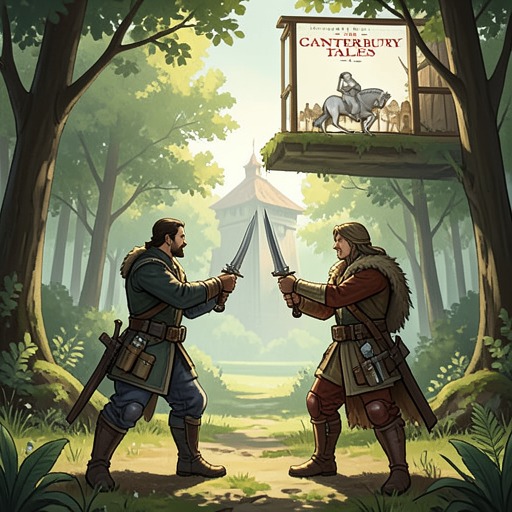
The grove duel of Palamon and Arcite
The Canterbury TalesThe grove duel of Palamon and Arcite is the pivotal encounter in which imprisonment gives way to pursuit, concealed love becomes declared rivalry, and a bond between two Theban knights is converted into armed conflict. Palamon’s escape brings him into the grove where Arcite is already present; Arcite’s account of his own love for Emily provokes Palamon into revealing himself; and their ensuing fight is interrupted only when Duke Theseus discovers them. The duel therefore does not resolve the contest for Emily: it exposes it, enlarges its stakes, and prepares the legal and ceremonial settlement that follows.
Causes and Setting
The immediate cause of the duel is Palamon’s escape from prison. With a friend’s help, he slipped out of his cell soon after midnight and fled the town as quickly as he could. His flight is driven by the opportunity to regain freedom, but the grove also becomes the place where his freedom is tested. He enters it without protection or public support, and at first hides in a bush, fearful for his life. The concealment gives him the position of a watcher: before he acts, he hears and recognizes the threat posed by Arcite’s presence.
The grove is thus both refuge and threshold. Palamon has crossed out of confinement but has not yet reached safety, while the private woodland removes the two knights from the authority that governs their imprisonment. Their meeting occurs away from witnesses and formal judgment, in a space where personal claims can momentarily replace law. Yet the isolation is unstable. The same setting that permits secret combat will soon be penetrated by Duke Theseus, whose arrival restores public authority and redirects the conflict toward an institutional solution.
Recognition and Provocation
While hidden, Palamon hears Arcite speak of loving Emily. The revelation strikes him with the force of a physical wound: he feels as though a cold sword has passed through his heart. His reaction is immediate and embodied. Anger shakes him; after hearing Arcite’s account, he leaps from the thicket with a deathly pale face, turning concealment into open accusation. The scene’s recognition is double-edged. Palamon discovers that Arcite, his former companion in captivity and chivalric fellowship, is also his rival, while Arcite discovers that the apparently absent figure has been listening and is now confronting him.
Palamon calls Arcite a false and wicked traitor because he understands Arcite’s love for Emily as a breach of their relationship. The charge is not merely romantic jealousy. It treats love as a matter of loyalty, obligation, and competing rights, so that Arcite’s desire becomes an act of betrayal. Palamon insists that Arcite must choose between surrendering the claim and facing him, making the conflict explicit: neither knight can continue to preserve both their fellowship and their identical claim to Emily.
Arcite responds with equal hostility when he turns and sees Palamon. The resentment in his heart makes him draw himself fiercely, like a lion. His answer does not dissolve the misunderstanding or restore their former alliance; instead, it confirms that both men regard the other’s love as intolerable. The emotional value of brotherhood shifts into suspicion and enmity, and the language of affection gives way to the language of challenge.
The Combat and Its Chivalric Form
Although the duel is born from jealousy, it is conducted through recognizable knightly forms. Palamon proposes that they meet secretly the next day, at a designated time and place, and gives his oath that he will be there. The promise converts uncontrolled anger into a formal appointment. Their conflict remains intensely personal, but the oath supplies it with a code: each man will face the other openly rather than rely on ambush or concealment.
When the appointed time arrives, each knight rides alone, carrying his horse and armor into the field between them. Their solitude emphasizes that neither comes as the representative of an army or a court. The field is the physical expression of their narrowed world, in which freedom, honor, love, and life appear to depend upon a single encounter. Yet the scene also retains the manners of chivalry. The two first help one another into armor as courteously as though they were brothers. That gesture preserves, for a moment, the relationship the duel is about to destroy: they prepare the body of the very opponent they intend to wound.
Once armed, they take sharpened, sturdy spears and plunge into a fight of extraordinary length. The combat is therefore neither a brief quarrel nor a symbolic threat. It is sustained, dangerous, and physically committed. Courtesy and violence coexist without being reconciled. Their behavior suggests that chivalric discipline can regulate the manner of conflict while leaving its underlying passion untouched; the rules make the duel possible, but they do not make the rivalry just.
Duke Theseus’s Intervention
The private contest ends when Duke Theseus reaches the open land while hunting. In the glaring sun he sees Palamon and Arcite fighting. He does not initially know who they are, but he immediately spurs his horse between them, draws his sword, and orders them to halt on pain of losing their heads. His intervention is sudden and absolute. The lovers’ duel, which had been arranged as a secret settlement, is interrupted by a ruler who possesses the power to impose a different settlement through judgment.
Theseus’s arrival changes the value at stake. Before he appears, the struggle is governed by the knights’ own oath and by the possibility that one will kill the other. Once he places himself between them, the contest becomes subject to political authority and public consequence. The duel has failed as a final solution: it has revealed the depth of their rivalry but has not determined a legitimate outcome. Theseus’s command prevents the private enforcement of their competing claims and prepares the later movement from uncontrolled combat to a formal tournament.
Consequences and Narrative Significance
The grove duel is the central turning point in the relationship between Palamon and Arcite. Their shared history does not disappear, but it is reorganized around competition for Emily. Each man’s love is now known to the other, and each understands that the other will not simply withdraw. The encounter also establishes the pattern that governs the rest of their story: desire produces conflict, conflict is interrupted or redirected by larger structures, and the outcome remains dependent on forces beyond either knight’s control.
The duel’s interruption is especially important because it preserves both men for a later public contest. Instead of ending in an unobserved killing, the conflict is carried forward into the arrangements made by Duke Theseus. The later tournament for Emily can therefore be read as the authorized, expanded successor to the grove fight: what began as two men meeting secretly with spears becomes a regulated spectacle under ducal supervision. The private field has exposed the emotional truth of the rivalry; the public arena will attempt to give that rivalry a socially acceptable form.
The scene also gains force from its contrast between pilgrimage and violence. The wider narrative begins with people desiring to set out on pilgrimage toward distant shrines, a movement associated with travel, devotion, and the hope of reaching a meaningful destination. Palamon’s midnight escape is another departure, but his journey leads not to a shrine: it leads into hiding, recognition, and combat. His flight replaces spiritual movement with desperate pursuit, showing how the narrative’s journeys can carry characters toward revelation without bringing peace.
Finally, the duel stands at the threshold of the story’s tragic and ceremonial developments. After the struggle, the narrative proceeds through prayers, organized combat, death, burial, and marriage rather than through the simple victory of one lover over another. The grove is where the rivalry first becomes visible in its full intensity; Duke Theseus’s interruption is what allows the tale to move from personal vengeance toward the larger sequence of tournament, loss, and final social reordering. The event’s decisive significance lies in that conversion: an illicit private battle becomes the origin of a public drama whose consequences reach beyond both combatants.